This is an installment of our ‘Member Spotlight’ series, in which we feature a CHES Member and share how their area of research and innovation is impacting health professions education. In doing so, we hope to help propagate ideas throughout the community and provide a mechanism by which CHES Members may identify opportunities for collaboration and expertise sharing.
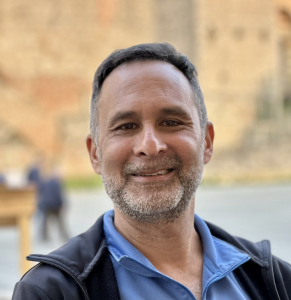
This issue focuses on Saleem Razack. Dr. Razack is first and foremost a Pediatric Intensive Care physician at BC Children’s Hospital. He always says that first because, for him, everything comes from his experiences as an educator of fellows, residents, advanced practice nurses, and medical students in the PICU. By “everything”, Dr. Razack means the research questions, mostly in equity and anti-racism, which have driven his research program in health professions education. Dr. Razack is appointed as a professor of pediatrics within the Department of Pediatrics at UBC and as a Scholar at the Centre for Health Education Scholarship.
How did you become involved in Health Professions Education (HPE) research and what drew you to this activity?
In many ways, I exemplify the community of practice idea of movement from “legitimate peripheral participation” to “full participation” in medical education scholarship and research. When I began my practice in PICU, I saw myself as a teacher, rather than as an educator. There were very few role models and educational interests were seen as secondary to more traditional biomedical research, so I would not have known that there was such a thing as an educator focused upon the pedagogy of medical or health professions education. All this changed when I attended a faculty development workshop at McGill, where I was for 25 years, on giving effective feedback to residents. I started to see that there might be a right way and a wrong way to engage in these educational actions, and that they could be studied. Plus, I found that there was a community of practice of many like minded individuals (FAC DEV devotees as I refer to them!) who saw the wonder in watching learners grasp new concepts and become trained professionals. Slowly I was drawn into the world of educational program leadership (first as a residency program director). I still count being a residency program director as the best job I ever had – 20 years later, I can look at the successes of the people I was fortunate to have in the program I was given the privilege to be the director of, and engage in a little avuncular pride for their accomplishments! In educational program leadership, the program was the generator of many research questions with respect to residency education, and I was again drawn into the world of educational research.
What have you been exploring in your current scholarship?
My focus has always been on building more equitable health care through attention to what is being taught, modelled and learned with respect to equity, diversity, inclusion, and anti-racism – in short how does social justice intersect with pedagogies of health professions education and how ought it to?
Currently, I am exploring the knowledge systems of medicine itself – what we teach and how we teach it – with respect to white supremacy, patriarchy, cis- and hetero- normativity, and ableism and how this came to be. Just prior to this interrogation, I was focussing on professional socialization with respect to these issues, but for me, the key point is that the very knowledge we teach – in journal club, when we misspeak and refer to “race” as the risk factor in some disease or the other, versus referring to “being racialized as’ or “experiencing racism as” as the true risk factor, or in the infectious diseases lecture where we only learn about being Gay when we learn about HIV, to give two examples—is imbued with power that includes the privileged and excludes the structurally marginalized.
What is the most important lesson you have learned from doing education research?
It is a journey where you encounter many friends, some of whom see the world or the phenomenon you are interested in through very different glasses than you do. And it is ok! Collaborate with them. Talk. Argue. Grow in your own understandings. I liken the field of health professions research to an agora of ideas. In this agora there are apples on sale with kumquats, mangoes, and occasionally partridgeberries from Newfoundland! By this I mean that one might access epidemiological methods, or critical discourse analysis, or ethnography, just to name a few, in order to apprehend the phenomenon of interest.
What HPE research finding or theory has had the greatest impact on your work?
Without a doubt, it has been critical discourse analysis. I have a huge confession: 20 years ago, I was googling people like Michel Foucault, Pierre Bourdieu, and Mikhail Bakhtin. Foucault, for me, was “that French power guy”. But I dug in; I read; and allowed my mind to expand into new ways of knowing.
I am in particular, very fond, of the work of Mikhail Bakhtin. His theories of language fit so well with the complex multi-voiced phenomena that we study today in health professions education. By complex and multi-voiced, I mean domains of study such as “competence” or “professionalism”, or “equity”.
What would you describe as your most significant contribution to HPE scholarship so far?
I was fortunate with colleagues to obtain a SSHRC grant to undertake a discourse analysis of the student selection process for entry into medicine. This is where I whet my appetite for critical discourse analysis. This was the first of its kind and occurred during a time where we were seeing studies that quantified disparities in medical classes in relation to the social demographics of society—so “what” kinds of questions—but no “why is it occurring” kinds of questions.
The greatest epiphany for me was to understand that the majority of “why” questions speak to the motivation of agents who participate in a particular phenomenon (e.g. “the selection of students for medicine”) and need to be studied through lenses of knowledge-power relationships.
One of the synthesis papers that resulted from this study is probably among my most cited.
What is your favorite part of the educational process? What keeps you inspired?
My favourite part of the educational process is watching people acquire expertise and clinical comfort – so this would be learning in day to day care of patients. My absolute favourite part of the process is to watch over two years how PICU fellows become intensivists. Our relationship is very close – through phone calls, discussing consults etc. I am given the privilege to glimpse into the minds and thought processes of these remarkable individuals. This inspires me and gives me a sense of great privilege.
What do you like to do outside of work?
I have 5 year old twins, and I am barely coping! We are two older Dads, and the physicality of it all is mindboggling! Seriously, they take up a lot of time and energy. So spending time with them is a key activity. For myself, I am an avid reader and cyclist, and I love to cook!