Presenter:
Meaghan MacNutt
Authors:
Meaghan MacNutt, Maï Yasué, Ahalya Satkunaratnam
Poster Abstract:
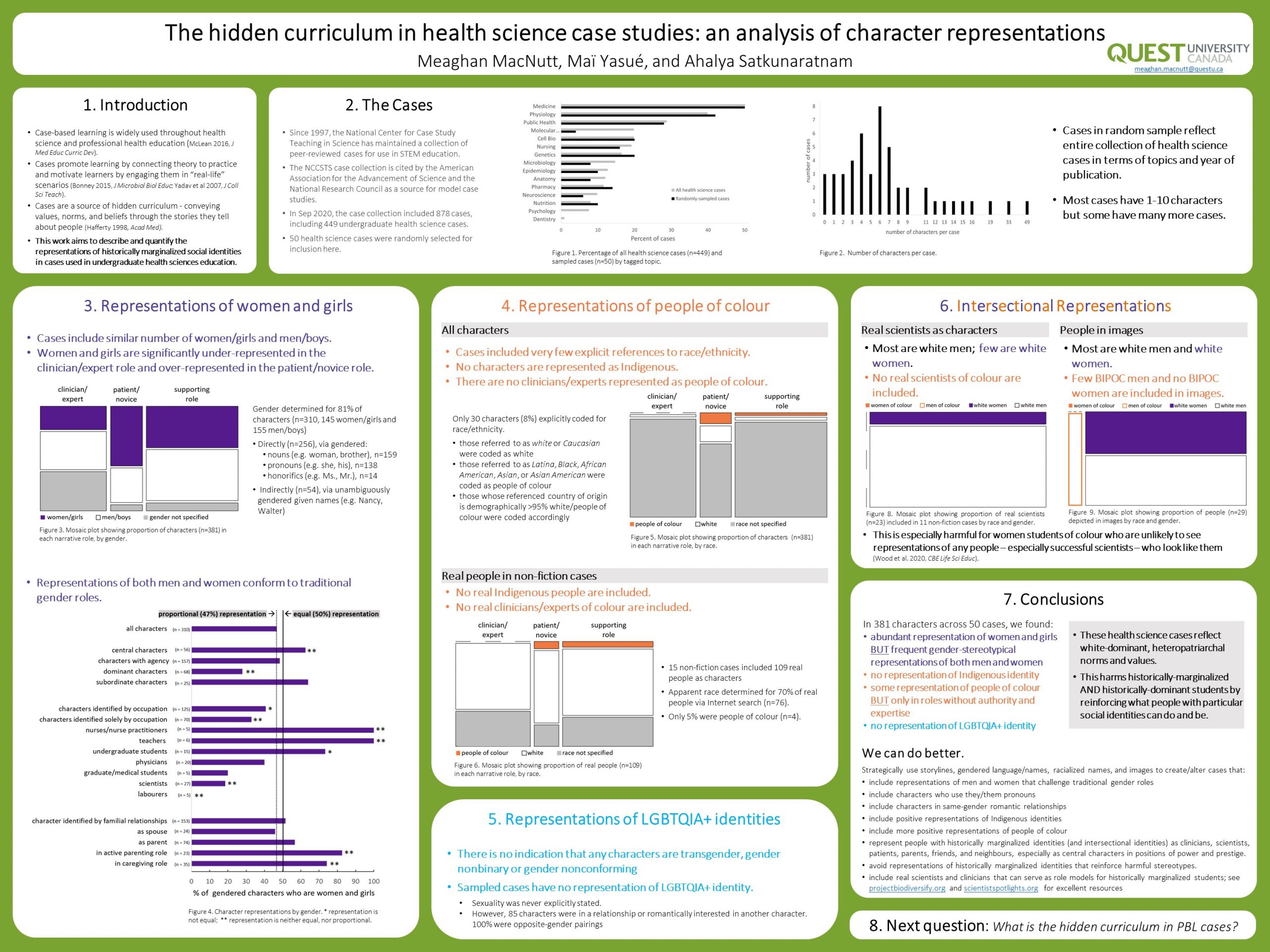
Case-based learning is widely used throughout pre-professional and professional health education. It is heralded as an effective pedagogical method for connecting theory to practice and for motivating learning by engaging students in “real-life” clinical scenarios. Clinical cases can also be considered a source of hidden curriculum – conveying values, norms, and beliefs through the stories they tell about people. In this way, clinical case studies provide a rich opportunity to tell stories that celebrate diversity and help students develop cultural, gender, and LGBTQIA+ competencies. This exploratory work will analyze character representations in health-related cases (n = 432) published in a large, peer-reviewed database (the National Centre for Case Study Teaching in Science). Each character’s role (i.e. patient, care provider, family member, friend) and identity (i.e. age, sex, gender, sexuality, ethnicity, religion) will be defined to the extent possible using implied and explicit descriptions from the case. Methods are currently under development to identify cases and characters where common stereotypes are disrupted or reinforced. By analyzing over 1000 characters across hundreds of cases, we will 1) describe and quantify the character identities that students encounter in health-related case studies; and 2) determine whether character representations signal equity and inclusivity as being key values of health educators.
Key words: diversity, inclusion, case-based learning