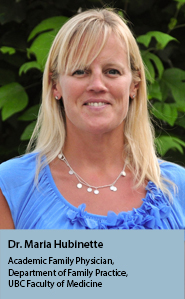
Dr. Maria Hubinette
Title – Rethinking health advocacy
Date: Wednesday, June 18, 2014
Time: 12:00pm to 1:30pm (Lunch will be served at DHCC)
Locations:
- Diamond Health Care Centre 2267
- IRC 305
- MSB 107
- KGH CAC 237
- NHSC 9-374
- FSJH 0715
- Surrey Central City (Manning Room)
Abstract
Health advocacy has been widely accepted as a key element of competency-based education in Canada. There is lack of agreement in the literature over the definition of health advocacy, and a range of understanding of what health advocacy entails. Although recognized as a professional responsibility, it is often seen as overwhelming, perhaps because it is framed conceptually as an activity that each physician should be doing on their own rather than as a collaborative process. Further, much of the language around health advocacy is framed as an activity that physicians will do for others: using their expertise to determine health needs of individuals and communities and addressing them in an authoritative fashion. Using some of the empiric findings from interviews with effective health advocates, I will offer some suggestions for how we might approach health advocacy differently.
Biography
Maria Hubinette is a born-and-bred Vancouverite, with stints away for school and travel. She is a practicing family physician with roles in medical education research and education leadership. Maria completed the UBC Clinical Educator Fellowship, a Masters in Medical Education from the University of Dundee and the UBC Faculty Certificate Program on Teaching and Learning in Higher Education in 2013.
Her research interests include qualitative methodologies, health advocacy in medical education, and professional identity formation. One of her goals through this research has been to challenge medical trainees and physicians to think more broadly about health care to include improvement and change to the health care system. Her clinical work focusses on youth and women’s health—particularly youth mental health, which informs much of her research. She is currently involved in education roles within both the undergraduate and postgraduate family medicine programs. She teaches small group seminars on a variety of clinical topics in the Family Medicine course in medical school. She is the course director for Family Practice years one and two in VFMP, is lead faculty for portfolio development in the undergraduate program, and is lead faculty for curriculum in the Family Practice postgraduate program.
Outside of the office, Maria enjoys cruising the coastal waters of BC aboard her sailboat, Dengue (yes, as in the fever!). She also enjoys participating in a variety of sports and outdoor activities with her kids.
Accreditation:
As an organization accredited to sponsor continuing medical education for physicians by the Committee on Accreditation of Canadian Medical Schools (CACMS), the UBC Division of Continuing Professional Development designates this educational program as meeting the accreditation criteria of the College of Family Physicians of Canada for up to 1.5 Mainpro-M1 credits (per session). This program has been reviewed and approved by UBC Division of Continuing Professional Development. Each physician should claim only those credits he/she actually spent in the activity.
Accreditation Statement:
The CHES Research Rounds is a self-approved group learning activity (Section 1) as defined by the Maintenance of Certification program of the Royal College of Physicians and Surgeons of Canada.